2025 AI Trends to Watch: The Year AI Became Infrastructure
March 2, 2025 by Asif Waliuddin
The artificial intelligence landscape in 2025 represents a pivotal transformation from experimental technology to essential infrastructure. As we approach the final quarter of 2025, several defining trends have emerged that fundamentally reshape how businesses, researchers, and society interact with AI systems. This year marks the transition from "generative AI as a novelty" to "AI as the backbone of digital transformation"—a shift that carries profound implications for entrepreneurs, technologists, and strategic planners.
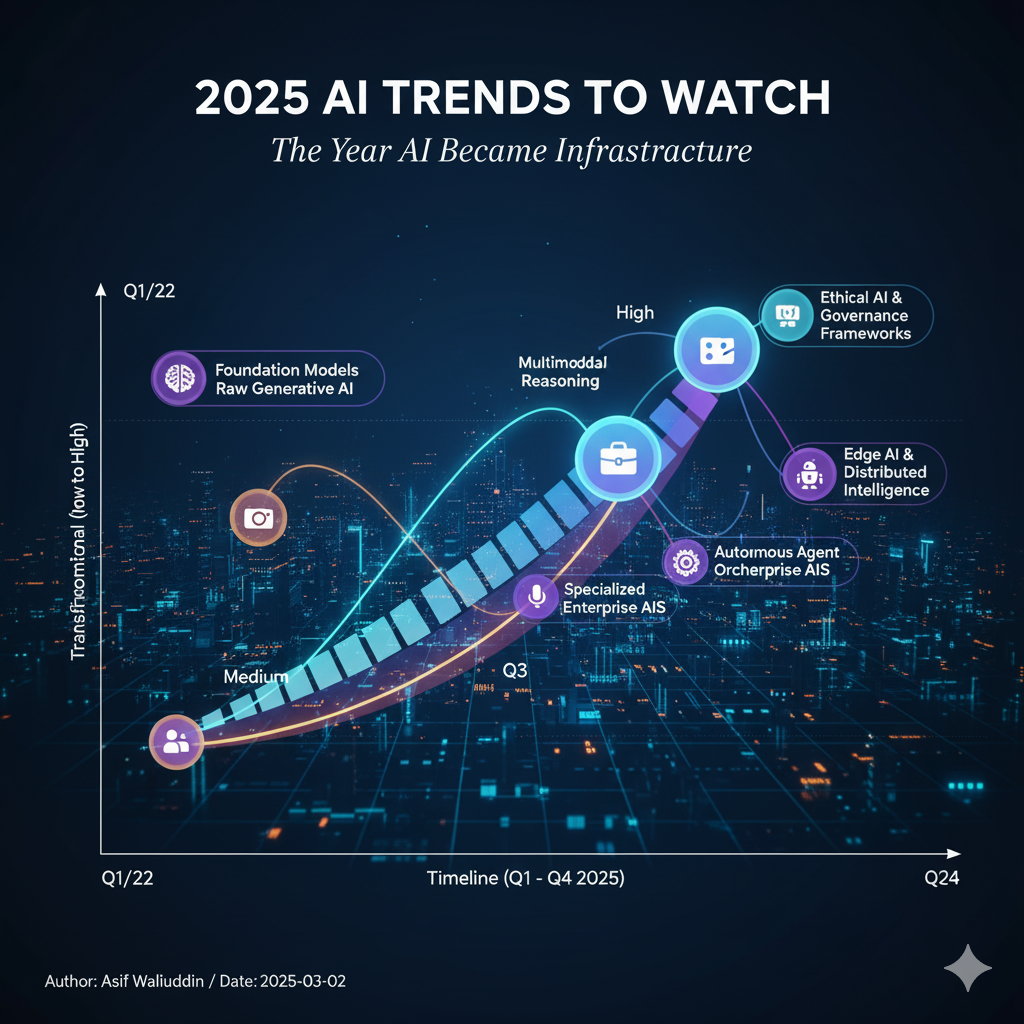
2025 AI Trends: Timeline and Impact Matrix showing when major AI developments emerged and their transformational impact on the industry
The timeline above illustrates how various AI developments have cascaded throughout 2025, with reasoning models, multimodal capabilities, and autonomous agents achieving transformational impact across industries. Unlike previous years focused on raw model capabilities, 2025 has been characterized by practical deployment, infrastructure challenges, and the emergence of specialized AI systems designed for specific enterprise needs.
Reasoning Revolution: Beyond Pattern Matching to True Problem-Solving
The OpenAI o1 Paradigm Shift
The release of OpenAI's o1 reasoning models in late 2024 and their widespread adoption throughout 2025 represents perhaps the most significant advancement in AI capabilities since the introduction of transformer architecture. Unlike traditional language models that generate responses through statistical pattern matching, o1 models employ a "chain-of-thought" reasoning process that mirrors human cognitive approaches to complex problem-solving.123
The technical breakthrough lies in the model's ability to spend variable amounts of inference time on problems based on complexity—simple queries receive immediate responses, while complex mathematical proofs or coding challenges may require several minutes of internal reasoning. This represents a fundamental paradigm shift from scaling model size to scaling inference-time compute, opening new possibilities for AI system performance without requiring exponentially larger training datasets.41
Performance metrics demonstrate the dramatic improvement: On the American Invitational Mathematics Examination (AIME), o1 solved 83% of problems compared to GPT-4o's 13% success rate. In competitive programming, the model reached the 89th percentile in Codeforces competitions, while achieving PhD-level performance in physics, chemistry, and biology benchmarks.523
Enterprise Applications and Business Impact
The reasoning capabilities have immediate practical applications across knowledge-intensive industries. Legal firms are deploying o1 models for contract analysis and legal research, where the model's ability to trace logical reasoning chains provides transparency crucial for professional liability. Scientific research organizations are utilizing these systems for hypothesis generation and experimental design, particularly in materials science and drug discovery where multi-step logical reasoning is essential.61
Software development teams report significant productivity improvements when using reasoning models for complex architectural decisions and debugging challenging systems. The model's ability to maintain coherent reasoning across extended problem-solving sessions makes it particularly valuable for tasks that previously required senior-level human expertise.14
Multimodal AI: When Machines Truly See, Hear, and Understand
The Convergence of Sensory Intelligence
2025 has witnessed the maturation of multimodal AI systems that seamlessly integrate text, images, audio, and video processing in ways that approach human-like comprehension. This represents a fundamental evolution from single-modality systems to AI that can understand context across multiple sensory inputs simultaneously.789
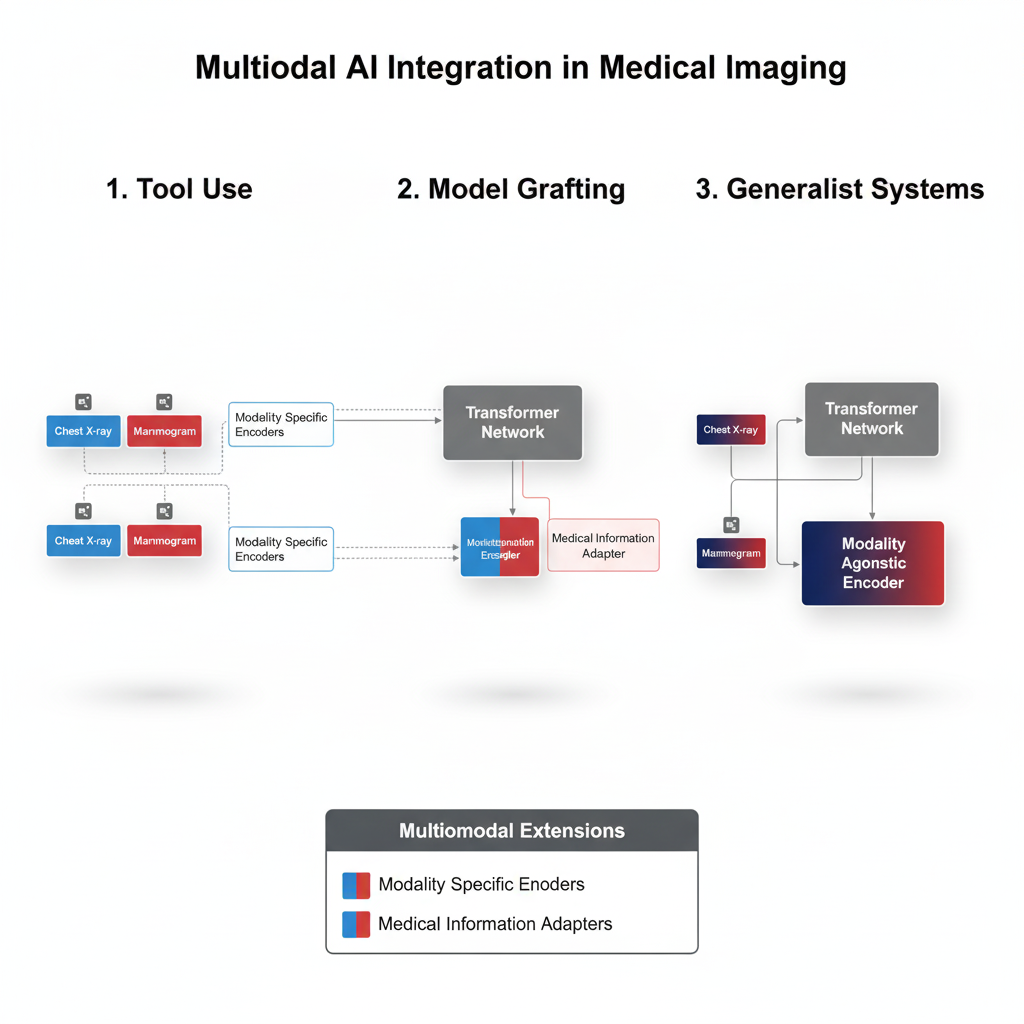
Visualization of three approaches for multimodal AI integration in medical imaging, highlighting how different encoders and adapters interact with transformer networks.
GPT-4o and Gemini 2.5 have set new standards for multimodal interaction, enabling real-time voice conversations with emotional expressiveness, visual reasoning from images and documents, and the ability to maintain context across different input types. These systems can analyze a photograph while listening to spoken instructions about that image and generate both textual explanations and appropriate actions—a capability that opens entirely new categories of human-computer interaction.89
Healthcare and Professional Services Transformation
The healthcare sector has emerged as a primary beneficiary of multimodal AI capabilities. Medical imaging systems now combine visual analysis of X-rays and MRIs with patient history text and physician notes to provide comprehensive diagnostic support. These systems can identify subtle patterns that might escape individual modality analysis, particularly in complex cases requiring correlation between multiple diagnostic inputs.1011
Customer service applications have evolved beyond simple chatbots to sophisticated agents that can interpret customer tone, analyze product images, understand written complaints, and coordinate appropriate responses across all communication channels. This holistic approach to customer interaction is driving significant improvements in resolution rates and customer satisfaction metrics.129
The market impact is substantial: The multimodal AI healthcare market alone is projected to expand from $1.1 billion in 2024 to $14.2 billion by 2034, representing a compound annual growth rate of approximately 29.3%. This growth reflects not just technological capability but genuine business value creation through improved outcomes and operational efficiency.10
The Rise of AI Agents: From Tools to Autonomous Teammates
Architectural Evolution Toward Autonomy
The progression from AI assistants to truly autonomous agents represents one of 2025's most significant developments. Unlike traditional AI tools that respond to direct prompts, modern AI agents operate with goal-directed behavior, multi-step planning capabilities, and the ability to adapt their approach based on environmental feedback.131214
Current agent capabilities span four distinct autonomy levels:13
- Level 1 (Chain): Rule-based automation with predetermined actions and sequences
- Level 2 (Workflow): Dynamic sequencing using AI routing while maintaining predefined actions
- Level 3 (Partially Autonomous): Goal-driven planning with minimal human oversight in specific domains
- Level 4 (Fully Autonomous): Cross-domain operation with proactive goal-setting and tool selection
Most enterprise deployments in 2025 operate at Levels 1 and 2, with select implementations exploring Level 3 capabilities in controlled environments. The technical challenges of achieving consistent Level 4 performance remain significant, particularly regarding safety, reliability, and alignment with human values.1513
Business Process Integration
Enterprise adoption of AI agents has accelerated dramatically throughout 2025, with nearly 70% of Fortune 500 companies now using AI agents for routine business processes. These implementations typically focus on high-volume, repetitive tasks where consistency and availability provide clear business value.6
Customer service agents can now handle complete interaction cycles from initial inquiry through resolution, including escalation to human agents when appropriate. Supply chain management systems deploy agents for real-time optimization of inventory, logistics, and vendor relationships, adapting to market conditions without human intervention.146
The economic impact extends beyond simple automation. Organizations report that AI agents enable human employees to focus on higher-value strategic work, creative problem-solving, and relationship management while agents handle operational complexity. This division of labor is creating new organizational structures optimized for human-AI collaboration.156
Hardware Infrastructure Crisis: The GPU Shortage Reshaping AI Strategy
Supply Chain Bottlenecks and Market Dynamics
The semiconductor shortage that began affecting general technology products has evolved into a specialized crisis focused on AI-optimized chips, particularly high-performance GPUs and specialized AI processors. NVIDIA allocated nearly 60% of its chip production to enterprise AI clients in Q1 2025, creating severe constraints for other market segments.161718
The shortage stems from multiple converging factors: manufacturing disruptions including a 6.4 magnitude earthquake affecting TSMC production, exponential growth in AI infrastructure demand, geopolitical tensions affecting supply chains, and the specialized nature of advanced chip manufacturing. These constraints are particularly acute for cutting-edge chips using sub-11nm manufacturing processes required for frontier AI models.1716
Advanced packaging has become a critical bottleneck. TSMC's Chip-on-Wafer-on-Substrate (CoWoS) capacity remains insufficient despite aggressive expansion efforts, with NVIDIA reportedly securing over 70% of available CoWoS-L capacity through 2025. This packaging technology is essential for the high-bandwidth memory connections required by advanced AI processors.17
Strategic Responses and Market Adaptations
The chip shortage has accelerated several strategic trends that will likely persist beyond the immediate supply constraints. Cloud providers are increasingly developing custom AI chips optimized for their specific workloads, reducing dependence on general-purpose GPU architectures. Google's TPUs, Amazon's Inferentia, and similar initiatives represent long-term shifts toward specialized, vertically integrated AI infrastructure.1718
Enterprise organizations are adapting through several approaches: multi-cloud strategies to access available compute resources across providers, increased focus on efficiency optimization to maximize performance from available hardware, and strategic partnerships with cloud providers to secure guaranteed compute allocations. These adaptations are creating new competitive dynamics where access to compute infrastructure becomes a strategic differentiator.1617
The shortage has also accelerated investment in alternative computing paradigms, including quantum-classical hybrid systems, neuromorphic processors, and photonic computing architectures. While these technologies remain largely experimental, the infrastructure constraints are driving increased research funding and commercial interest in post-silicon computing approaches.18
Investment Patterns: AI Capital Allocation Reaches Historic Peaks
Venture Capital Concentration and Mega-Rounds
AI startups attracted $192.7 billion in venture capital investment through the first three quarters of 2025, setting records and representing approximately 46% of all global venture funding. This concentration represents a fundamental shift in venture capital allocation, with 2025 positioned to become the first year where AI companies receive more than half of total VC investment globally.192021
The three largest funding rounds exemplify this trend: Anthropic's $13 billion raise, xAI's $5.3 billion round, and Mistral AI's $2 billion investment. These mega-rounds reflect both the capital intensity of AI development and investor confidence in transformative potential. However, the concentration also creates challenges for non-AI startups competing for remaining capital.19
Investment patterns reveal a bifurcation between foundation model companies receiving massive rounds and specialized application companies securing smaller but still substantial funding for specific use cases. This suggests a maturing market where general-purpose AI capabilities are becoming commoditized while specialized applications retain significant value creation potential.2019
Strategic Investment Themes
Corporate venture capital has become increasingly important in AI investment, with strategic investors contributing approximately 25% of AI funding globally. These investments often include technology partnerships, data sharing agreements, and integration commitments that provide startup companies with market access beyond pure financial capital.22
Geographic distribution remains highly concentrated: The United States attracted $60 billion (nearly two-thirds) of global Q3 venture funding, with AI investments heavily clustered in Silicon Valley. This concentration raises questions about global competitiveness and access to AI capabilities across different economic regions.19
The investment focus has shifted from pure research to practical deployment and commercialization. Investors are prioritizing companies with clear paths to revenue generation, proven use cases, and sustainable business models rather than pursuing basic research or speculative technology development.2019
Regulatory Acceleration: From Policy Discussions to Legal Frameworks
State-Level Implementation and Federal Uncertainty
AI regulation in 2025 has been characterized by active state-level implementation amid federal policy uncertainty. Colorado's AI Act took effect in February 2025, making it the first state to implement comprehensive regulations for high-risk AI systems in employment and consumer contexts. This represents a template that multiple other states are adapting for their own regulatory frameworks.23242526
State lawmakers introduced 210 AI-related bills across 42 states during 2025, with approximately 9% (20 bills) being enacted into law. These regulations typically focus on use-specific contexts rather than technology-broad approaches, particularly emphasizing disclosure requirements, safety protocols for sensitive applications, and automated decision-making oversight.23
The federal approach has shifted significantly with the change in presidential administration. The "Removing Barriers to American Leadership in Artificial Intelligence" executive order directed agencies to review and potentially rescind Biden-era AI policies perceived as impediments to innovation. This creates tension between federal deregulation efforts and state-level regulatory initiatives.242627
International Competitive Dynamics
The regulatory landscape reflects broader geopolitical competition for AI leadership. The European Union's comprehensive approach contrasts with the U.S. emphasis on innovation-first policies, while China's regulatory framework focuses on state control and strategic technology development.282327
Industry responses vary significantly based on regulatory jurisdiction and business model. Companies operating across multiple states must develop compliance strategies accounting for varying requirements, creating preference for federal standardization while managing current fragmentation.2324
The regulatory uncertainty affects investment decisions, talent allocation, and technology development priorities. Companies are increasingly factoring regulatory compliance costs into product development timelines and go-to-market strategies.2527
Video Generation and Creative AI: Democratizing Visual Content Creation
Technical Capabilities and Market Competition
AI video generation has evolved from experimental demonstrations to practical production tools throughout 2025. OpenAI's Sora, despite regulatory limitations in some regions, has catalyzed competitive development across multiple platforms including Runway ML, Luma AI, and emerging alternatives like xAI's Grok Imagine.29303132
The technical capabilities now include: text-to-video generation with coherent narratives lasting up to 60 seconds, image-to-video animation with realistic physics and lighting, video-to-video editing and style transfer, and audio-visual synchronization for complete multimedia production. These capabilities are approaching broadcast quality for many use cases, enabling professional content creation without traditional video production resources.3029
Platform differentiation has emerged around specific strengths: Runway focuses on cinematic quality and professional tools, Luma AI emphasizes photorealistic 3D environments, Pictory specializes in converting written content to video, and newer entrants like fal.ai compete on speed and cost efficiency. This specialization suggests a maturing market with distinct use case optimization.3129
Business Applications and Content Strategy Impact
Marketing and communications teams have rapidly adopted AI video generation for social media content, product demonstrations, and advertising creative. The ability to produce high-quality video content without filming equipment, actors, or post-production teams is transforming content marketing economics and enabling rapid iteration on creative concepts.2930
Educational content creators are leveraging these tools for training materials, online courses, and instructional videos where consistency, cost control, and rapid updates provide significant advantages over traditional video production. Corporate communications teams use AI video generation for internal communications, product announcements, and stakeholder presentations.3029
Quality and authenticity considerations remain important factors in deployment decisions. While technical quality has improved dramatically, human audiences can still detect AI-generated content in many contexts, requiring careful consideration of brand positioning and audience expectations.3230
Humanoid Robotics: From Demonstration to Deployment
Technical Progress and Real-World Capabilities
Humanoid robotics has progressed significantly beyond viral demonstration videos to practical deployment in controlled environments. Figure AI's Figure 03 robot, selected as one of TIME's best inventions of 2025, demonstrates capabilities including autonomous laundry folding, dishwasher loading, and basic household task completion.33343536
The technical capabilities advancing most rapidly include intelligence and perception systems, powered by generative AI enabling high-level reasoning, planning, and spatial awareness. Vision sensors approach human capabilities in many contexts, though gaps remain in low-light conditions and handling reflective or transparent objects. Dexterity and fine motor control continue improving but remain below human performance for precision tasks.33
Battery performance remains a significant limitation, with most humanoids operating approximately two hours before requiring recharging. This constraint limits deployment to environments supporting continuous charging or operational models incorporating battery swapping systems.33
Commercial Deployment Strategies
Early commercial applications focus on semi-structured environments where humanoid capabilities provide value without requiring full autonomy. Warehouse logistics, manufacturing line feeding, and materials handling represent initial deployment targets where existing automation infrastructure can support humanoid integration.3334
Investment in the sector reached $2.5 billion during 2024, with multiple companies including Tesla, 1X, and various well-funded startups pursuing different technological approaches. Figure AI alone raised over $1 billion at a $39 billion valuation, indicating significant investor confidence in commercial viability timelines.3433
The progression toward broader deployment follows predictable stages: industrial workflows in controlled environments first, variable service environments next, and eventually unstructured real-world applications once dexterity and energy density improvements enable full-shift operation.3533
Small Language Models: Efficiency Meets Specialization
The Case for Focused AI Systems
Counter to the prevailing "bigger is better" trend in AI development, 2025 has witnessed significant growth in small language model (SLM) deployment for specialized applications. The global SLM market is projected to grow from $0.93 billion in 2025 to $5.45 billion by 2032, with a compound annual growth rate of 28.7%.373839
SLMs, typically defined as models with fewer than 7 billion parameters, offer several advantages for specific use cases: dramatically reduced computational requirements enabling edge deployment, faster inference times critical for real-time applications, enhanced privacy through local operation without cloud dependencies, and easier customization for domain-specific tasks.384037
Enterprise adoption is accelerating particularly for applications requiring consistent performance on well-defined tasks rather than general-purpose capabilities. Customer service chatbots, document classification systems, and specialized analysis tools represent primary deployment areas where SLMs often outperform larger models on relevant metrics.3938
Business Applications and Edge Computing Integration
The convergence of SLMs with edge computing infrastructure creates new deployment possibilities for AI capabilities. Manufacturing environments deploy SLMs for real-time quality control, predictive maintenance alerts, and process optimization without requiring cloud connectivity or dealing with latency constraints.414243
Mobile and IoT applications benefit significantly from SLM capabilities, enabling sophisticated language processing on resource-constrained devices. This enables new categories of applications including offline language processing, privacy-sensitive document analysis, and real-time conversational interfaces in bandwidth-limited environments.3840
The economic benefits extend beyond technical performance. SLMs require significantly lower infrastructure investment for deployment and operation, making advanced AI capabilities accessible to organizations that cannot justify the costs associated with large model deployment.394038
Quantum Computing and AI Convergence
Technical Breakthroughs and Commercial Deployment
2025 has marked significant progress in quantum computing with direct implications for AI development. China's deployment of the "Zuchongzhi 3.0" superconducting quantum computer for commercial use represents a milestone in practical quantum computing availability. The system, featuring 105 readable qubits, is accessible through cloud platforms for algorithm development and testing.44454647
Microsoft's introduction of the Majorana 1 chip represents a fundamental breakthrough in quantum computing architecture. The topological approach promises significantly improved qubit stability and scalability, with projections suggesting million-qubit systems within years rather than decades. This timeline acceleration has immediate implications for AI algorithm development and optimization.47
Current quantum-AI applications focus on optimization problems, materials simulation, and cryptographic applications where quantum advantages are most pronounced. While general-purpose quantum advantage for AI training remains theoretical, specialized applications in drug discovery, materials science, and financial modeling show practical potential.4546
Strategic Implications for AI Development
The convergence of quantum computing capabilities with AI systems creates new possibilities for algorithm design and problem-solving approaches. Quantum-enhanced machine learning algorithms, hybrid classical-quantum systems, and quantum-optimized neural network architectures represent active research areas with potential commercial applications.454647
Investment patterns reflect growing confidence in quantum-AI convergence, with significant funding for companies developing quantum software platforms, hybrid computing systems, and quantum-optimized AI algorithms. This represents a strategic bet on post-classical computing paradigms that could provide competitive advantages in specific AI applications.4645
The timeline for practical quantum-AI systems remains uncertain, but 2025 has established the foundational infrastructure and demonstrated proof-of-concept applications that suggest accelerated development in subsequent years.444745
AI Safety and Alignment: From Research to Implementation
Industry Safety Frameworks and Practices
AI safety research has evolved from academic exercise to practical implementation requirement throughout 2025. The Future of Life Institute's AI Safety Index provides standardized evaluation criteria for leading AI companies, assessing actual safety practices rather than stated commitments.484950
Current safety priorities include: developing reliable methods for detecting and preventing AI systems from engaging in deceptive behavior, implementing robust monitoring and control systems for internal AI deployment, creating effective oversight mechanisms for increasingly autonomous AI systems, and establishing industry standards for risk assessment and mitigation.495048
Corporate safety investments vary significantly across leading AI companies, with OpenAI, Anthropic, and Google leading in published safety research and implemented safety protocols. However, evaluation reveals significant gaps between stated safety commitments and verifiable implementation across the industry.48
Technical Safety Research Directions
Active safety research areas include: scalable oversight mechanisms for AI systems operating beyond direct human evaluation capability, alignment techniques ensuring AI systems pursue intended objectives even under optimization pressure, interpretability research enabling understanding of AI decision-making processes, and robustness research preventing system failures under adversarial conditions.4950
The research community emphasizes practical safety techniques that can be implemented with current technology rather than theoretical approaches requiring breakthrough advances. This focus on implementable safety measures reflects urgency around deploying increasingly capable AI systems safely.5049
Collaborative safety research initiatives between companies, academic institutions, and government organizations are expanding, indicating growing recognition that AI safety challenges require coordinated rather than competitive approaches.484950
Looking Forward: Strategic Implications for 2026 and Beyond
Convergence and Integration Trends
The AI trends emerging throughout 2025 point toward several convergence patterns that will likely accelerate in 2026. The integration of reasoning capabilities with multimodal interfaces will enable AI systems that can understand complex, multi-faceted problems and develop sophisticated solution approaches. This convergence creates possibilities for AI systems that can manage entire business processes rather than individual tasks.178
Autonomous agents operating with advanced reasoning capabilities represent a natural progression from current Level 2 and Level 3 implementations toward more capable Level 4 systems. This evolution will likely reshape organizational structures and job requirements as AI systems become capable of independent project management and strategic decision-making within defined parameters.131214
The hardware infrastructure crisis will likely accelerate development of specialized computing architectures optimized for specific AI workloads rather than general-purpose systems. This specialization could create competitive advantages for organizations developing optimized hardware-software integration rather than relying on general-purpose cloud computing resources.161718
Business Strategy Considerations
Organizations must now consider AI capability as fundamental infrastructure rather than optional enhancement. The competitive advantages emerging from AI integration in 2025 suggest that businesses without comprehensive AI strategies will face increasing disadvantage in operational efficiency, customer experience, and product development capabilities.63839
Investment strategies should account for the rapid pace of AI capability development while avoiding over-commitment to specific technological approaches that may become obsolete. The concentration of venture capital in AI sectors creates both opportunities for startups with differentiated approaches and challenges for businesses competing for technical talent and market attention.192021
Regulatory compliance will increasingly become a competitive factor as state and international regulatory frameworks mature. Organizations developing compliance-first AI strategies may gain sustainable advantages over competitors retrofitting safety and regulatory compliance into existing systems.232425
The transformation of AI from experimental technology to essential infrastructure throughout 2025 establishes the foundation for even more dramatic changes in subsequent years. Success in this environment requires balancing aggressive adoption of proven AI capabilities with careful risk management around rapidly evolving technologies and regulatory requirements. The organizations that navigate this balance effectively will likely define competitive leadership in the AI-transformed economy of the late 2020s.
Footnotes
-
https://openai.com/index/introducing-openai-o1-preview/ ↩ ↩2
-
https://codefinity.com/blog/Introducing-OpenAI-o1-preview:-The-Future-of-AI-Reasoning ↩ ↩2
-
https://news.microsoft.com/source/features/ai/6-ai-trends-youll-see-more-of-in-2025/ ↩ ↩2 ↩3 ↩4 ↩5
-
https://www.linkedin.com/pulse/multimodal-ai-2025-year-machines-truly-see-hear-think-econsulate-wxocc ↩ ↩2
-
https://www.timesofai.com/industry-insights/top-multimodal-ai-models/ ↩ ↩2 ↩3
-
https://www.crescendo.ai/news/latest-ai-news-and-updates ↩ ↩2
-
https://www.apideck.com/blog/ai-agents-explained-everything-you-need-to-know-in-2025 ↩ ↩2 ↩3
-
https://aws.amazon.com/blogs/aws-insights/the-rise-of-autonomous-agents-what-enterprise-leaders-need-to-know-about-the-next-wave-of-ai/ ↩ ↩2 ↩3 ↩4
-
https://www.kubiya.ai/blog/top-10-ai-agent-frameworks-for-building-autonomous-workflows-in-2025 ↩ ↩2
-
https://www.runpod.io/articles/guides/gpu-scarcity-is-back-heres-how-to-avoid-it ↩ ↩2 ↩3 ↩4
-
https://markets.financialcontent.com/dailypennyalerts/article/tokenring-2025-10-3-the-enduring-squeeze-ais-insatiable-demand-reshapes-the-global-semiconductor-shortage-in-2025 ↩ ↩2 ↩3 ↩4 ↩5 ↩6
-
https://markets.financialcontent.com/stocks/article/tokenring-2025-10-15-beyond-the-gpu-specialized-ai-chips-ignite-a-new-era-of-innovation ↩ ↩2 ↩3 ↩4
-
https://news.crunchbase.com/venture/global-vc-funding-biggest-deals-q3-2025-ai-ma-data/ ↩ ↩2 ↩3 ↩4 ↩5 ↩6
-
https://www.crescendo.ai/news/latest-vc-investment-deals-in-ai-startups ↩ ↩2 ↩3 ↩4
-
https://www.bloomberg.com/news/articles/2025-10-03/ai-is-dominating-2025-vc-investing-pulling-in-192-7-billion ↩ ↩2
-
https://fpf.org/blog/the-state-of-state-ai-legislative-approaches-to-ai-in-2025/ ↩ ↩2 ↩3 ↩4 ↩5
-
https://fairnow.ai/what-do-artificial-intelligence-regulations-look-like-in-2025/ ↩ ↩2 ↩3 ↩4
-
https://www.jacksonlewis.com/insights/year-ahead-2025-tech-talk-ai-regulations-data-privacy ↩ ↩2 ↩3
-
https://www.whitecase.com/insight-our-thinking/ai-watch-global-regulatory-tracker-united-states ↩ ↩2 ↩3
-
https://commission.europa.eu/news-and-media/news/keeping-european-industry-and-science-forefront-ai-2025-10-08_en ↩
-
https://starryai.com/en/blog/sora-alternatives ↩ ↩2 ↩3 ↩4 ↩5
-
https://www.imagine.art/blogs/8-top-sora-ai-alternatives-to-consider-2025-review ↩ ↩2 ↩3 ↩4 ↩5
-
https://www.reddit.com/r/SaaS/comments/1o3lc3q/best_sora_2_api_alternatives_in_2025_for_free/ ↩ ↩2
-
https://www.bain.com/insights/humanoid-robots-from-demos-to-deployment-technology-report-2025/ ↩ ↩2 ↩3 ↩4 ↩5 ↩6
-
https://www.forbes.com/sites/annatong/2025/10/15/two-ai-startups-have-each-raised-100-million-to-build-humanoid-robots-in-stealth/ ↩ ↩2 ↩3
-
https://time.com/collections/best-inventions-2025/7318493/figure-03/ ↩ ↩2
-
https://www.f22labs.com/blogs/what-are-small-language-models-slms/ ↩ ↩2
-
https://www.bitdeer.ai/en/blog/small-language-models-vs-large-language-models-power-practicality-and-the-future-of-agentic-ai/ ↩ ↩2 ↩3 ↩4 ↩5 ↩6
-
https://hbr.org/2025/09/the-case-for-using-small-language-models ↩ ↩2 ↩3 ↩4
-
https://newsroom.intel.com/artificial-intelligence/intel-accelerates-ai-at-the-edge-through-open-ecosystem ↩
-
https://www.convox.com/blog/ai-edge-computing-infrastructure-2025 ↩
-
https://stlpartners.com/articles/edge-computing/50-edge-computing-companies-2025/ ↩
-
https://thequantuminsider.com/2025/10/14/china-opens-its-superconducting-quantum-computer-for-commercial-use/ ↩ ↩2
-
https://quantumzeitgeist.com/quantum-computing-future-2025-2035/ ↩ ↩2 ↩3 ↩4
-
https://news.microsoft.com/source/features/innovation/microsofts-majorana-1-chip-carves-new-path-for-quantum-computing/ ↩ ↩2 ↩3 ↩4
-
https://futureoflife.org/ai-safety-index-summer-2025/ ↩ ↩2 ↩3 ↩4
-
https://alignment.anthropic.com/2025/recommended-directions/ ↩ ↩2 ↩3 ↩4 ↩5
-
https://forum.effectivealtruism.org/posts/8k6qXNEogoHiBRsjA/technical-ai-safety-research-taxonomy-attempt-2025 ↩ ↩2 ↩3 ↩4 ↩5
-
https://www.aljazeera.com/economy/2025/10/9/ai-investments-are-pulling-the-us-economy-forward-will-it-continue ↩
-
https://www.pwc.com/gx/en/issues/artificial-intelligence/ai-jobs-barometer.html ↩
-
https://etcjournal.com/2025/10/13/three-biggest-ai-stories-in-october-2025/ ↩
-
https://www.mckinsey.com/capabilities/mckinsey-digital/our-insights/the-top-trends-in-tech ↩
-
https://menlovc.com/perspective/2025-the-state-of-consumer-ai/ ↩
-
https://www.ropesgray.com/en/insights/alerts/2025/08/artificial-intelligence-h1-2025-global-report ↩
-
https://insurancenewsnet.com/oarticle/october-15-2025-innovation-at-the-speed-of-ai ↩
-
https://www.npr.org/2025/01/31/1228085791/ai-artificial-intelligence-mit-cows-methane ↩
-
https://talent500.com/blog/ai-revolution-october-2025-software-development-trends/ ↩
-
https://www.morganstanley.com/insights/articles/ai-trends-reasoning-frontier-models-2025-tmt ↩
-
https://www.weforum.org/publications/top-10-emerging-technologies-of-2025/ ↩
-
https://pub.towardsai.net/2025s-biggest-ai-shocks-4-breakthroughs-that-changed-everything-992751b975a7 ↩
-
https://congruentx.com/what-are-ai-agents-a-beginners-guide-to-autonomous-ai-systems-2025/ ↩
-
https://learn.microsoft.com/en-us/azure/ai-foundry/openai/how-to/reasoning ↩
-
https://www.forbes.com/sites/lutzfinger/2025/01/06/multimodal-ai-in-2025-from-healthcare-to-ecommerce-and-beyond/ ↩
-
https://www.techloy.com/ai-continues-to-power-a-global-rebound-in-startup-funding/ ↩
-
https://www.deloitte.com/us/en/insights/industry/technology/technology-media-telecom-outlooks/semiconductor-industry-outlook.html ↩
-
https://www.reuters.com/technology/artificial-intelligence/chinas-h3c-warns-nvidia-ai-chip-shortage-amid-surging-demand-2025-03-27/ ↩
-
https://www.ey.com/en_us/insights/growth/venture-capital-investment-trends ↩
-
https://www.rila.org/blog/2025/09/ai-legislation-across-the-states-a-2025-end-of-ses ↩
-
https://www.tomshardware.com/pc-components/gpus/nvidia-is-turning-gpus-into-capital-questions-exist-around-circularity ↩
-
https://www.fastcompany.com/91411181/computing-chips-foundational-technology-next-big-things-in-tech-2025 ↩
-
https://news.berkeley.edu/2025/08/27/are-we-truly-on-the-verge-of-the-humanoid-robot-revolution/ ↩
-
https://www.reddit.com/r/runwayml/comments/1g15tb0/comparison_table_for_the_leading_ai_video_gen/ ↩
-
https://www.bankofengland.co.uk/report/2025/the-boes-approach-to-innovation-in-ai-dlt-quantum-computing ↩
-
https://www.reddit.com/r/ChatGPT/comments/1lzw9hr/open_ais_sora_vs_the_8_leading_ai_video_models/ ↩
-
https://www.devopsschool.com/blog/top-10-ai-edge-computing-solutions-tools-in-2025-features-pros-cons-comparison/ ↩
-
https://www.ciscolive.com/c/dam/r/ciscolive/global-event/docs/2025/pdf/BRKCOM-1009.pdf ↩
-
https://finance.yahoo.com/news/small-language-models-smls-company-090100930.html ↩
-
https://www.lesswrong.com/posts/bcuzjKmNZHWDuEwBz/an-outsider-s-roadmap-into-ai-safety-research-2025 ↩
-
https://www.otava.com/blog/top-edge-computing-platforms-for-2025/ ↩